
Get the full EPUB
Drop your email and the EPUB downloads straight to your device. We'll also ping you when the next case file lands — unsubscribe any time.
Your email is already on file — enjoy the read.
Download the EPUBAn emperor gives away Rome, puts its bishop above other churchmen, and moves his own government east. The Donation of Constantine turns that extraordinary story into an imperial grant. The text is medieval; the emperor it claims as its author died in 337.
Copied into legal collections and invoked in disputes about papal authority, the Donation acquired a long political life. Its critics had to do more than call it false: they had to show where its language and chronology betrayed it.
Early medieval
The document claims that Constantine granted Sylvester Rome, Italy and the western regions. Its author is unknown; its exact date and place of composition remain disputed. An eighth-century Roman setting is one influential explanation.
Centuries
The Donation circulated in medieval legal collections. Acceptance and interpretation varied; its history includes challenges as well as claims made on its authority.
1440
Lorenzo Valla writes a sustained attack on the supposed grant, examining its historical claims, language and internal anachronisms.
Unknown
The forger has not been identified. The 1929 Lateran Treaty settled a modern territorial dispute; it was not the first Catholic acknowledgement of the forgery.
The Evidence
The Propaganda
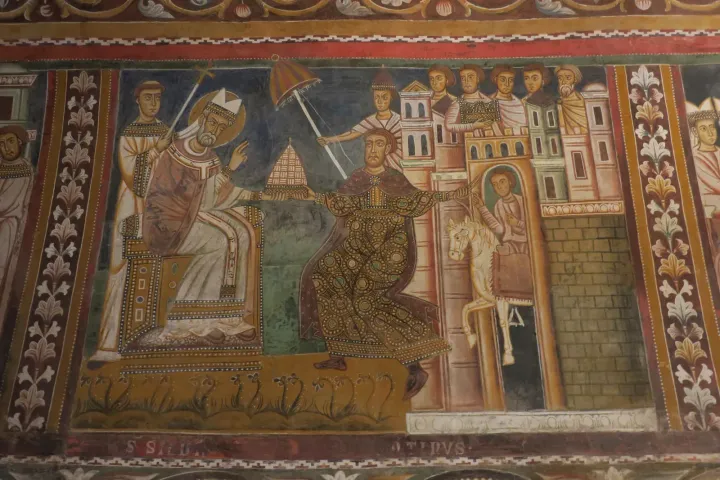
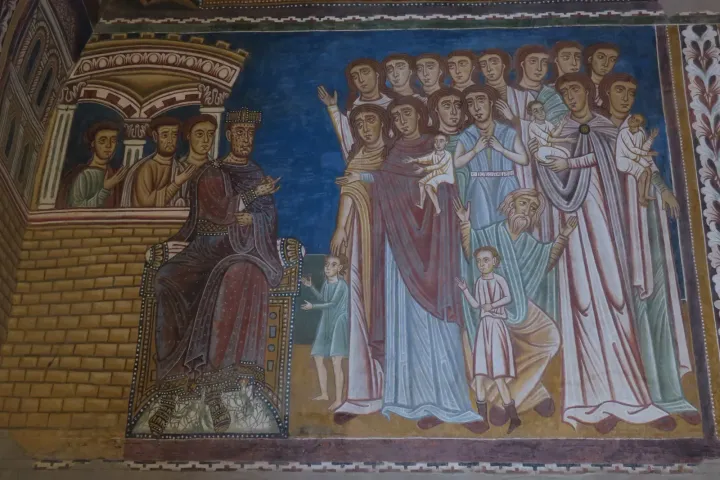
The thirteenth-century frescoes in the Chapel of San Silvestro show the legend of Constantine and Sylvester, including imperial deference to the bishop. Painted in an age of conflict between papacy and empire, the cycle turned claims about authority into a story viewers could see.
The Walk to Canossa
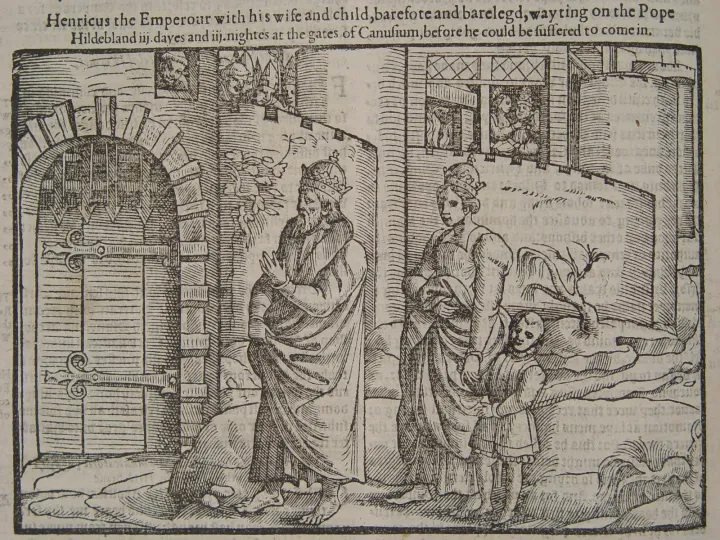
Gregory VII excommunicated King Henry IV in 1076 and released his subjects from their oaths of loyalty. At Canossa in January 1077, Henry sought and received absolution. Gregory’s account describes three days of penitence. The episode involved royal opponents, church appointments and apostolic authority; it cannot be explained as the consequence of one forged grant.
The Anachronisms
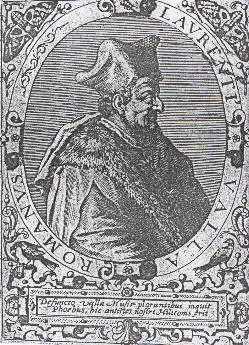
Valla questioned the use of satraps for Roman associates and the treatment of Constantinople as a leading ecclesiastical see before it had acquired that position. His criticism combined language with chronology. Later study extended the case; not every modern objection to the full Donation appears in Valla’s text.
A Document and Its Afterlife
The Forgery
The Donation is composed in the early Middle Ages, commonly associated with the eighth century. Its precise origin is uncertain. It circulates in ninth-century Frankish collections.
The Schism
A letter in Leo IX’s name invokes the Donation during the dispute with Constantinople. The excommunications of 1054 become a landmark in a longer estrangement between the Latin and Greek churches.
Canossa
King Henry IV receives absolution from Gregory VII at Canossa. Their political struggle continues. Henry is not crowned emperor until later.
The Proof
Valla writes his critique while serving Alfonso of Aragon. It circulates in manuscript. His inquisitorial proceeding in 1444 concerns a wider set of theological and philosophical controversies.
The Explosion
Hutten publishes an edition of Valla’s critique. Luther encounters the argument around 1520 and uses the forgery in his polemic against Rome.
The Lateran Treaty
The Holy See and Italy settle the Roman Question and establish Vatican City. The treaty does not announce the discovery or first acknowledgement of the Donation’s falsity.
Key Figures
Lorenzo Valla
Italian humanist (c. 1406–1457) who wrote his attack on the Donation in 1440 while serving Alfonso of Aragon. His later employment under Nicholas V shows that criticism of the document did not prevent a career in papal service.
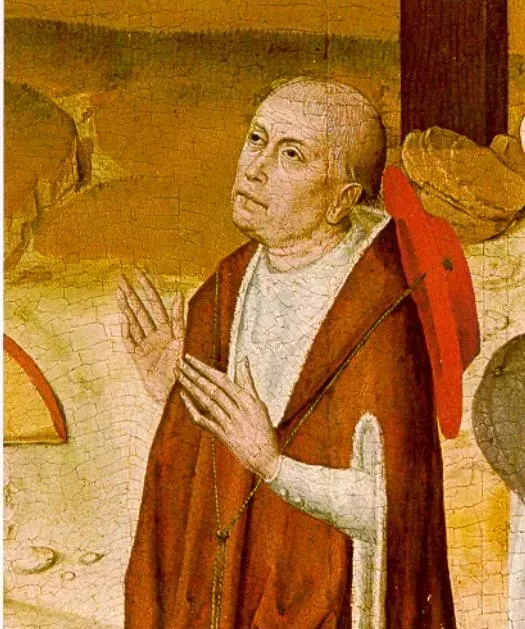
Nicholas of Cusa
German scholar and later cardinal (1401–1464). In De concordantia catholica in the early 1430s, he challenged the Donation’s authenticity. He did not stop short of rejecting it; Valla’s later achievement should not erase his contribution.
The Life of a Forgery
The Donation moved from legend to legal collection to painted image. Its authority depended on readers and institutions that found uses for it. Its exposure reveals that history more clearly than a story of one lie controlling a millennium.
Catholic scholars acknowledged the forgery long before 1929. The enduring mystery concerns its origin and transmission, not whether Constantine really signed away the West.
Get the Full Book
Follow the legendary emperor, the medieval claims, and the scholars who tested a document against the history it purported to record.