The Tunguska Event
The Explosion That Shook the World
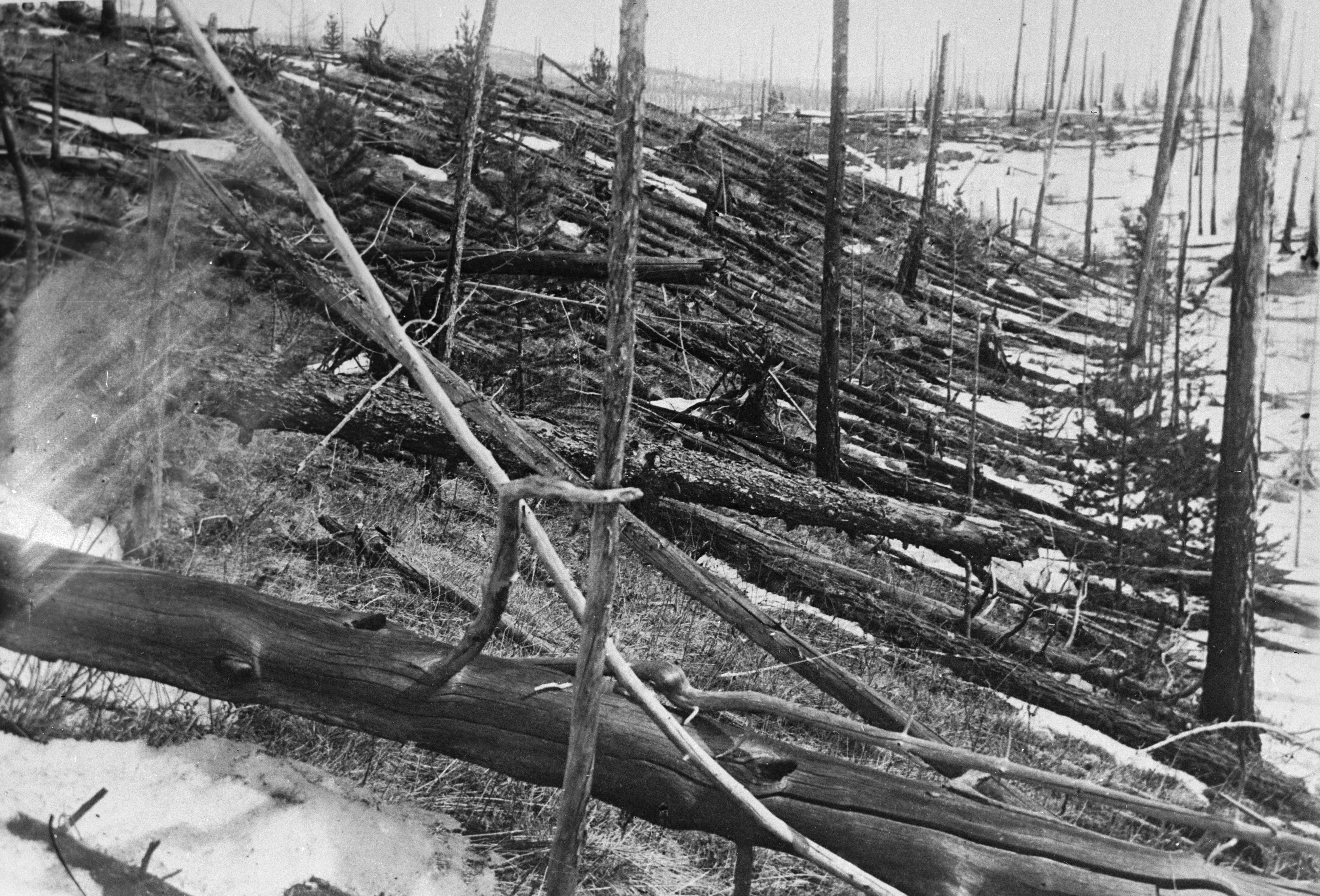
On the morning of June 30, 1908, something fell from the sky over central Siberia and exploded with the force of a thousand Hiroshima bombs. The blast flattened 80 million trees across 830 square miles of taiga. Windows shattered 400 miles away. The shockwave circled the earth twice. For days afterward, the skies over Europe glowed so brightly that Londoners could read newspapers at midnight.
No crater was found. No fragments were recovered. For 19 years, not a single scientist visited the site.
10-15 MT
Megatons of TNT equivalent. A thousand times the Hiroshima bomb. The largest impact event in recorded human history — and it struck one of the most remote places on earth.
2,150 km²
Of forest flattened. Larger than London.
None
No impact crater. No fragments. The object vanished.
19 yrs
Between the explosion and the first scientific expedition to the site.
The Evidence
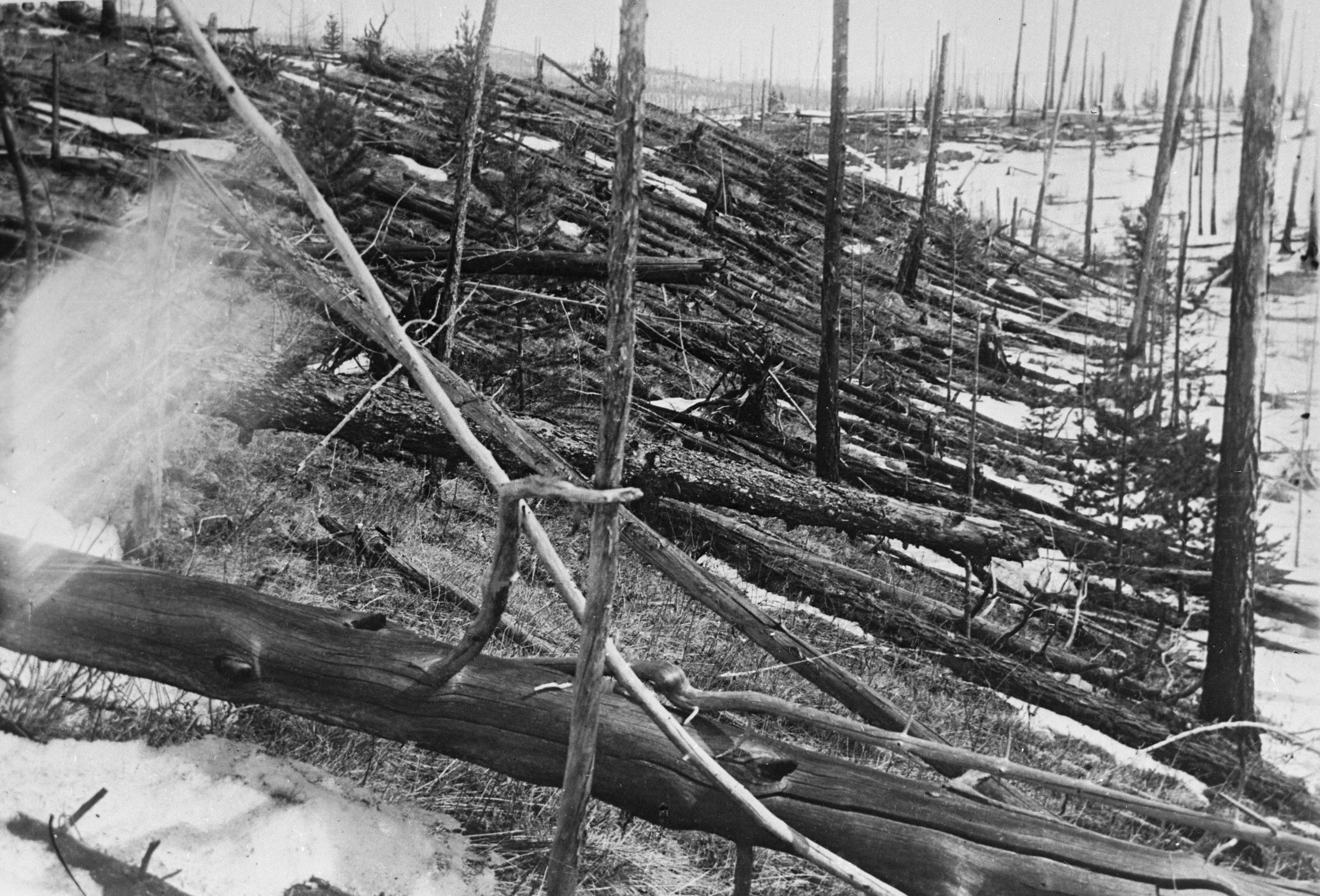
The Flattened Forest
Eighty million trees knocked flat in a radial pattern — all pointing away from a single epicentre. At the very centre, stripped trunks stood upright like telegraph poles, evidence that the explosion came from directly above. No crater, no impact site — just devastation so complete it looked like the work of an invisible hand.
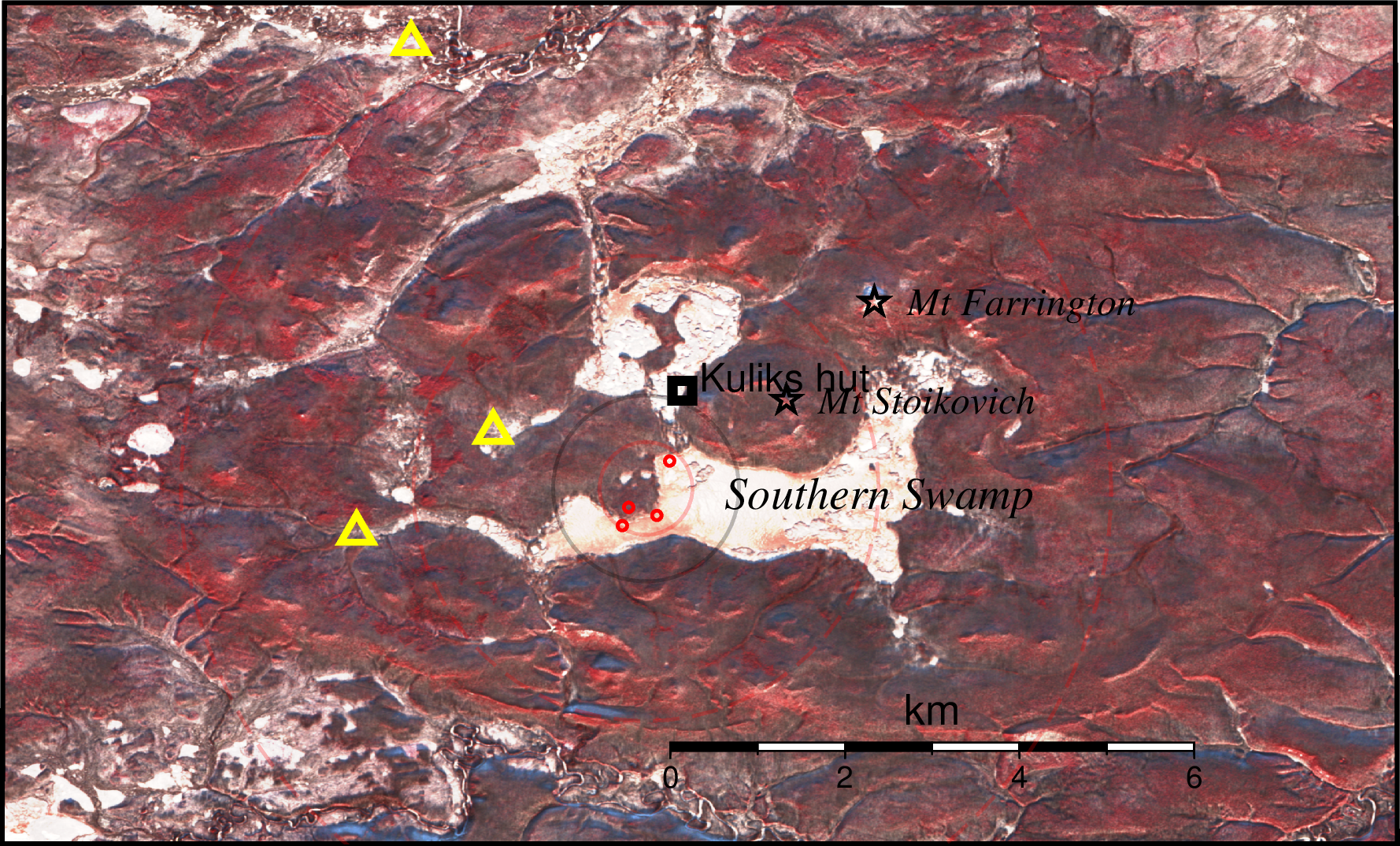
The Ghost Forest
At ground zero, trees were stripped of every branch and needle but left standing — bare poles thrusting at the sky. This pattern is the signature of an aerial explosion directly overhead. Kulik found marshy bog where he expected an impact crater. Whatever destroyed this forest did so without touching the ground.
The Aerial Survey
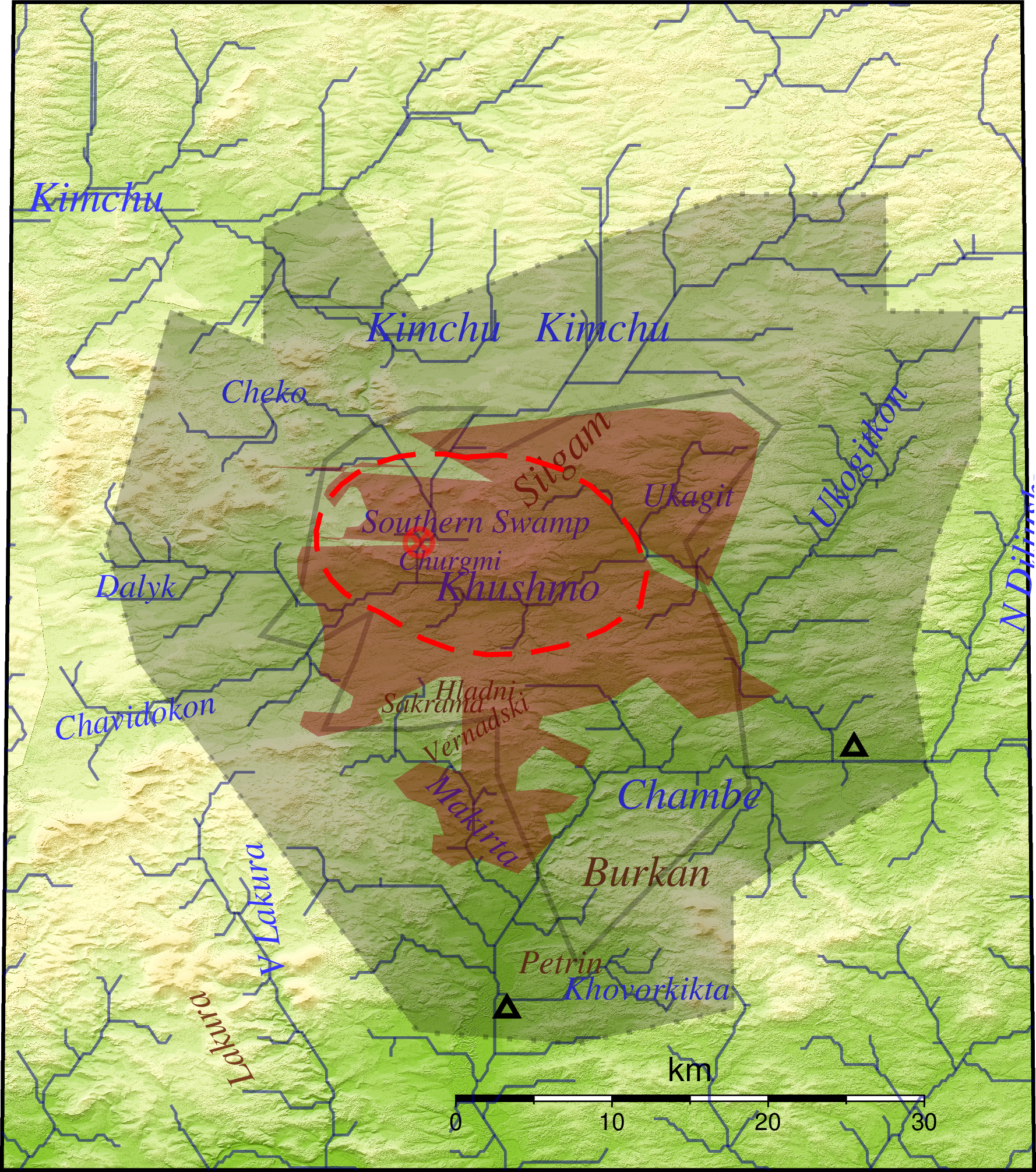
Kulik's 1938 aerial photographs revealed a butterfly-shaped destruction pattern — asymmetric, elongated in the direction of the object's travel. This confirmed the object entered from the southeast at an oblique angle and exploded while still in motion. The pattern spans over 2,150 square kilometres of Siberian taiga.
The Sky Breaks Open
The Explosion
At 7:17 a.m. on June 30, an object explodes in the atmosphere above the Podkamennaya Tunguska River. The blast is heard 700 km away. Seismographs worldwide register a magnitude 5.0 earthquake. The shockwave circles the earth twice.
Kulik Arrives
Soviet mineralogist Leonid Kulik becomes the first scientist to reach the blast zone — 19 years after the event. He finds miles of fallen trees in radial rows but no crater and no meteorite fragments. His photographs make the event world-famous.
The Alien Theory
Inspired by Hiroshima, Soviet engineer Alexander Kazantsev publishes a story proposing the explosion was caused by an alien nuclear-powered spacecraft. The theory becomes a cultural sensation and spawns decades of UFO speculation.
The Verdict
Orbital modelling gives an 83% probability the object was an asteroid. Microscopic spherules found in the soil support a stony body that vaporised completely in the atmosphere. But the debate is not over.
Chelyabinsk
A 20-metre asteroid explodes over Chelyabinsk, Russia, injuring 1,500 people. The largest airburst since Tunguska. A vivid reminder that the next impact could strike a populated area.
Key Figures
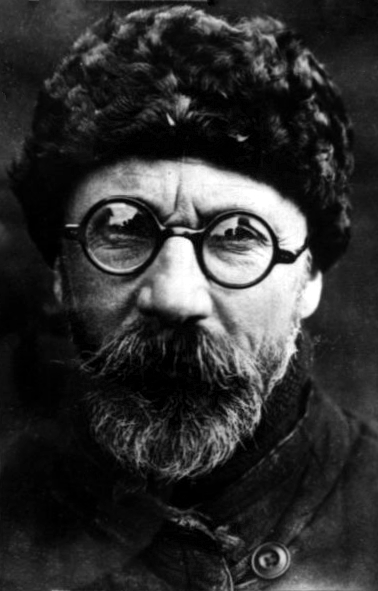
Leonid Kulik
Soviet mineralogist who led four expeditions to the blast zone between 1927 and 1938. He spent years searching for meteorite fragments in the Siberian bogs and never found them. Died of typhus in a German POW camp in 1942.

The Evenki People
The Shanyagir clan of Evenki nomads were camped just 20 km from the epicentre. They lost reindeer, shelters, and everything they needed for survival. No investigation or aid was ever sent. Their oral traditions preserved the earliest accounts of the event.
The Sky Gives No Warning
The Tunguska Event was the largest impact event in recorded history — and it happened in one of the emptiest places on earth. Had the object arrived four hours and forty-seven minutes later, it would have struck St Petersburg.
The next Tunguska-class asteroid is out there, somewhere in the darkness between the planets. The sky gives no warning, and the forest does not look up.
Get the Full Book
The complete story of the explosion, the investigation, the theories, and the warning that Tunguska still carries for our world.