
Get the full EPUB
Drop your email and the EPUB downloads straight to your device. We'll also ping you when the next case file lands — unsubscribe any time.
Your email is already on file — enjoy the read.
Download the EPUBOn the night of 28 May 1898, Italian photographer Secondo Pia developed a glass plate in his darkroom and discovered a striking visual effect: the faint, blurry image on a medieval linen cloth was itself a photographic negative. The positive face appeared on his negative plate. The tonal reversal made the figure more readily recognisable; it does not establish a date or production method.
Thirty-three scientists spent 120 hours examining every centimetre of the cloth in 1978. STURP rejected paint as an adequate explanation of the body image; microscopist Walter McCrone disagreed. These competing interpretations do not overturn the medieval radiocarbon result.
4.37m
Length of the linen. Width: 1.10 metres. Woven in a 3-over-1 herringbone pattern consistent with first-century manufacture. The cloth bears the front and back impressions of a crucified man approximately 1.75–1.80 metres tall.
200nm
Nanometres — the image penetrates only the outermost surface of the linen threads. One two-hundredth of a human hair. No known medium applied by hand can produce this.
1325 AD
Median date from 1988 radiocarbon test by Oxford, Zurich, and Arizona labs. Fiercely contested due to disputed sample location.
AB
The rarest major blood type — found in approximately 5% of the global population. Immunochemical tests identify the stains as blood with real serum halos, indicating clotting occurred.
The Evidence
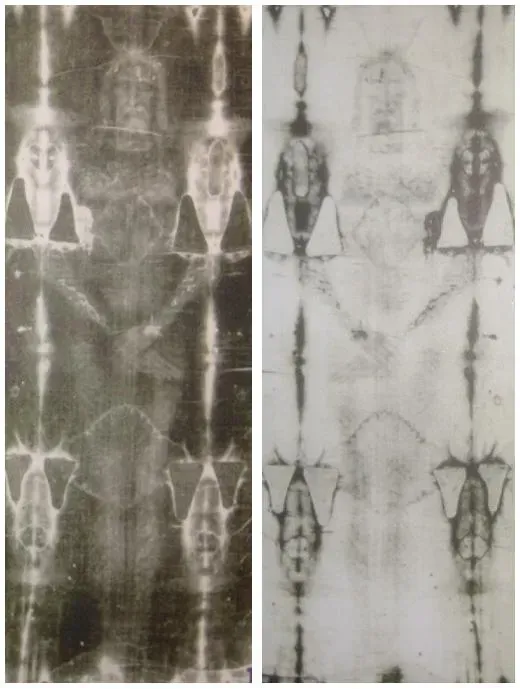
The Negative Image
The Shroud's image is a photographic negative. Under ordinary light, the cloth shows only a faint, brownish impression — barely recognisable. But when photographed and the negative plate developed, a fully formed portrait appears. The tones reverse. The image was formed as a negative centuries before negative photography existed. The negative-like appearance does not, by itself, establish authenticity or require knowledge of photography.
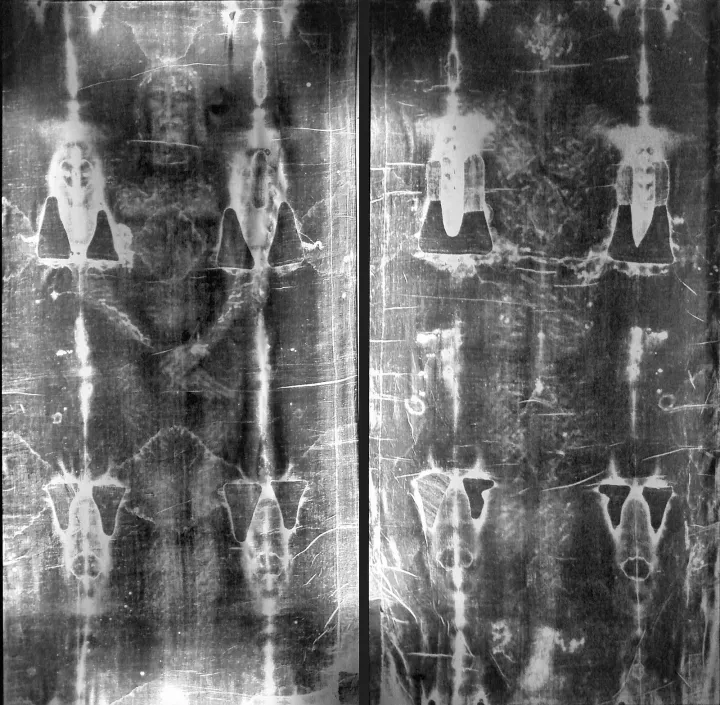
Three-Dimensional Data
In 1976, USAF scientists John Jackson and Eric Jumper fed photographs of the Shroud into a VP-8 Image Analyzer — a machine designed for lunar surface mapping. Unlike normal photographs, which produce distorted results in a VP-8, the Shroud yielded a mathematically precise three-dimensional relief. The image encodes distance information between cloth and body point by point. No known image-making process produces this property.
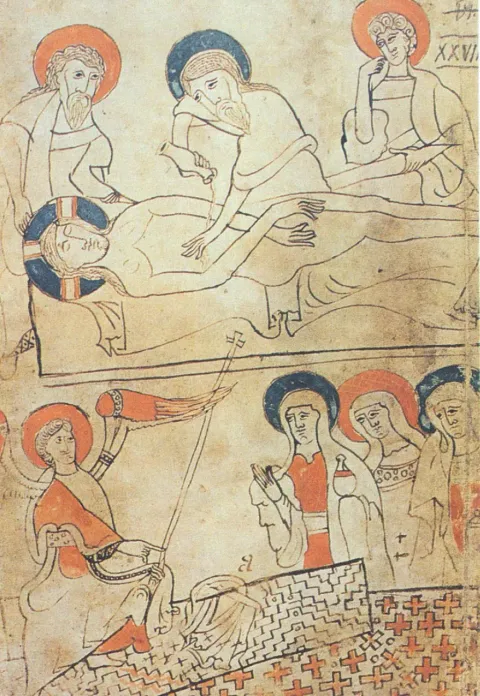
The Pray Codex
A Hungarian illuminated prayer manuscript from 1192 AD contains a miniature of Christ's burial that shows a cloth with a distinctive L-shaped pattern of four holes. The exact same four-hole pattern — caused by a thermal event predating the 1532 fire — appears on the Shroud today. If the artist was depicting the Shroud accurately, the cloth existed at least 165 years before its first documented appearance in France in 1357.
Six Centuries of Controversy
First Appearance
The cloth surfaces at Lirey, France, in the hands of Jeanne de Vergy, widow of knight Geoffroi de Charny. Bishop Henri de Poitiers immediately condemns it as fraudulent. No confession document is ever produced.
The Fire
Fire destroys the Sainte-Chapelle at Chambéry. A drop of molten silver burns through the folded cloth, leaving characteristic triangular scorch marks. Poor Clare nuns apply repair patches that would later complicate carbon dating.
Secondo Pia's Discovery
Amateur photographer Secondo Pia makes the first photographs of the Shroud and discovers in his darkroom that the image is a photographic negative. His hands tremble. "I was overcome with emotion," he later writes.
The STURP Examination
33 scientists from the Shroud of Turin Research Project arrive with six tonnes of equipment for 120 hours of analysis. STURP rejected paint as an adequate explanation of the body image. McCrone argued for pigments; the interpretations remain in conflict.
The Carbon Date
Three independent laboratories announce simultaneous results: the Shroud linen dates to 1260–1390 AD. The headlines declare it a medieval fake. The controversy over the sample location — and whether it was original cloth — begins immediately.
Key Figures
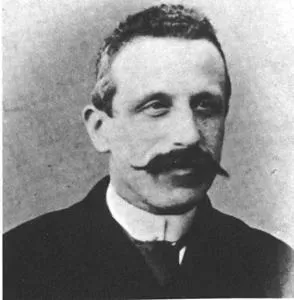
Secondo Pia
An Italian lawyer and amateur photographer, Pia was granted permission to photograph the Shroud in 1898. When he developed his negative plates, he became the first person to see the full portrait hidden in the cloth's image — a positive face appearing where the negative should have been. His discovery launched a century of scientific investigation.
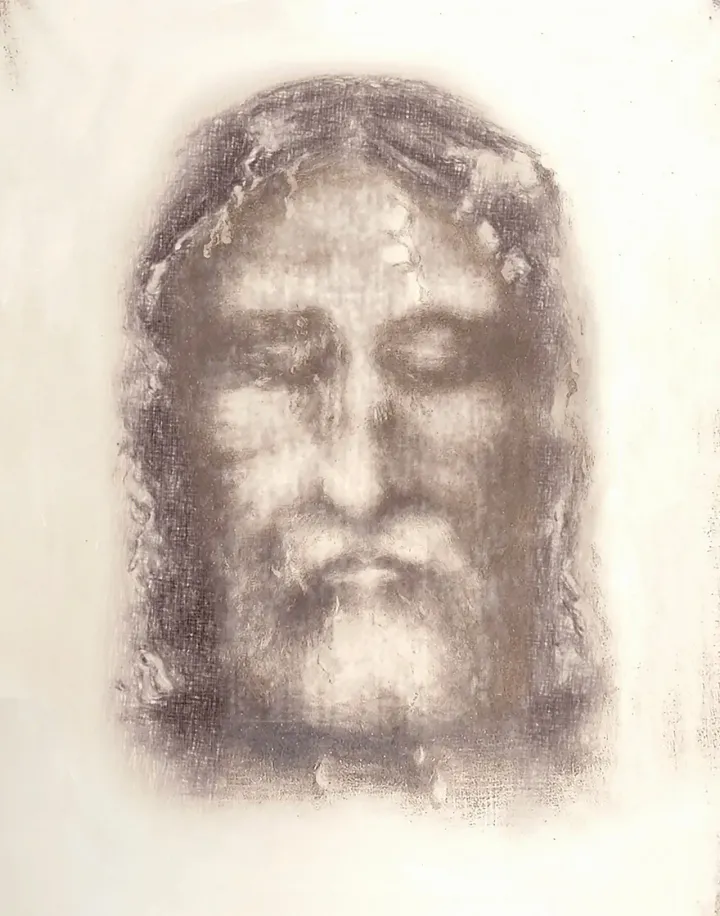
The Man in the Shroud
A male, approximately 1.75–1.80 metres tall, with blood type AB. The wounds correspond with Roman crucifixion: nail marks through the wrists (not the palms), scourge marks consistent with a Roman flagrum, a cap of thorns rather than a circlet, and a spear wound in the side. The wounds reflect first-century execution knowledge that no medieval European artist is known to have possessed.
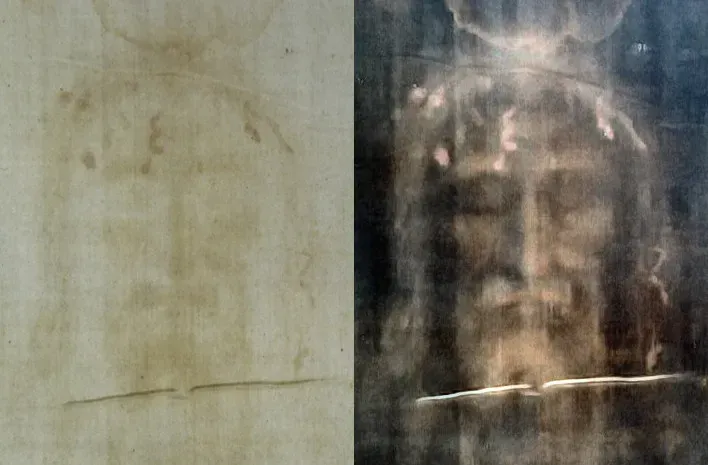
Nobody Knows
The sampled linen yielded a medieval radiocarbon date. Claims about stains, pollen, image formation and sampling objections require separate evaluation; they are not a set of agreed findings that establishes an ancient origin.
An unidentified manufacturing method does not prove that medieval makers lacked the ability to produce the cloth. Age, manufacture and religious identity are separate questions.
The cloth is a test. It tests our methods. And it still has no answer.
Get the Full Book
The complete story of the photograph, the fire, the scientists, the carbon date — and the question that has no answer.