Were Ninjas Real?
The Truth Behind History's Most Mythologised Spies
The word "ninja" did not appear in a Japanese dictionary until 1974. The real practitioners were called shinobi — and the documents they left behind describe something far stranger and more interesting than the black-clad assassin of cinema: professional spies who disguised themselves as monks, farmers, and merchants, and whose primary weapon was patience.
Three remarkable manuals survive from the 17th century. They do not describe superhumans. They describe a rigorous intelligence tradecraft — infiltration, psychological manipulation, long-term deep cover operations — developed over two centuries of Japan's most violent era. The myth came later, from theater, from fiction, from cinema. The reality was already remarkable enough.
3
Complete shinobi manuals survive from the 17th century: the Bansenshukai (1676, 22 volumes), the Shoninki (1681), and the Ninpiden. None describes supernatural powers. All describe intelligence tradecraft: disguise, infiltration, psychological warfare, and the suppression of visible emotion under interrogation.
Iga
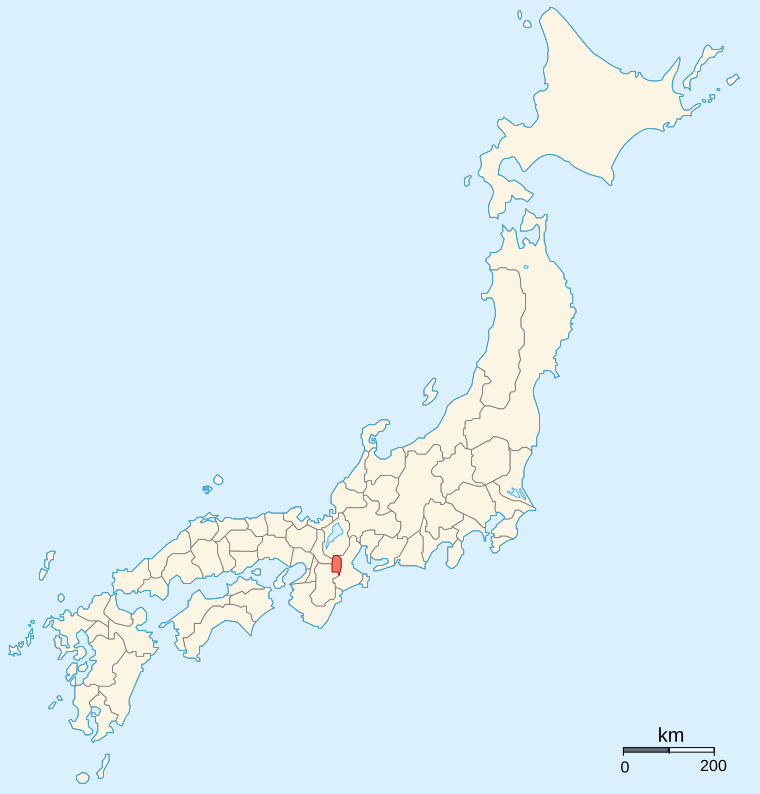
Iga Province (modern Mie Prefecture) had no resident daimyo — making its jizamurai families available for hire by any warlord. Geography and political independence created Japan's first mercenary intelligence contractors.
40,000
Estimated size of Oda Nobunaga's force in the 1581 Tensho Iga no Ran — the military campaign that destroyed the independent Iga confederacy. The province was devastated. The survivors scattered across Japan, taking their knowledge with them.
7
The Bansenshukai lists seven classic disguise categories (shichi ho de): mountain priest, wandering monk, merchant, craftsman, performer, physician, farmer. None of them involves black clothing.
The Evidence
The Real Shinobi
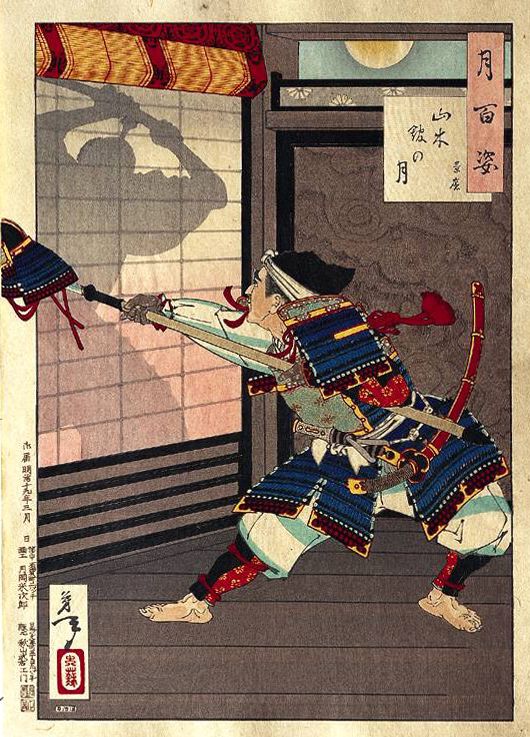
The shinobi of the Sengoku period were not superhumans. They were mercenary intelligence operatives from two mountain provinces — Iga and Koka — whose independence from any single daimyo made them available for hire by any warlord willing to pay. Their primary activities were espionage, infiltration, and psychological warfare. The Bansenshukai manual is explicit: the highest shinobi skill was the ability to embed yourself in an enemy community for months, undetected, gathering information. Not assassination. Not acrobatics. Patient, disciplined intelligence work.
The Real Consequences
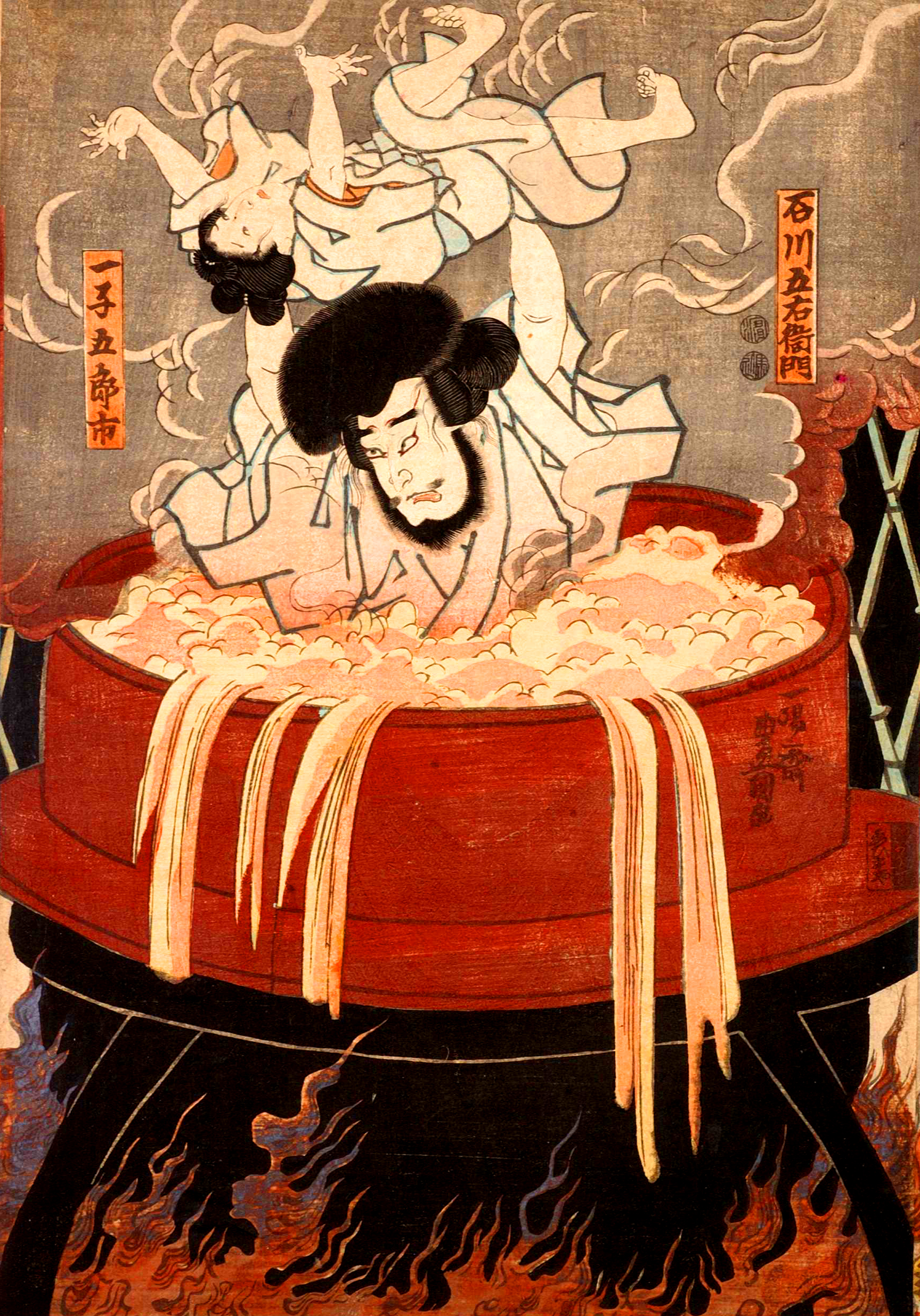
Ishikawa Goemon (c. 1558–1594) is among the most documented real figures associated with shinobi activity — a legendary outlaw and folk hero who allegedly attempted to assassinate the warlord Toyotomi Hideyoshi. Captured, he and his family were publicly boiled alive in an iron cauldron. The theatrical image shows the reality the manuals warned against: a detected shinobi was a dead shinobi. The Bansenshukai's first principle was concealment precisely because exposure meant this.
Where the Myth Began
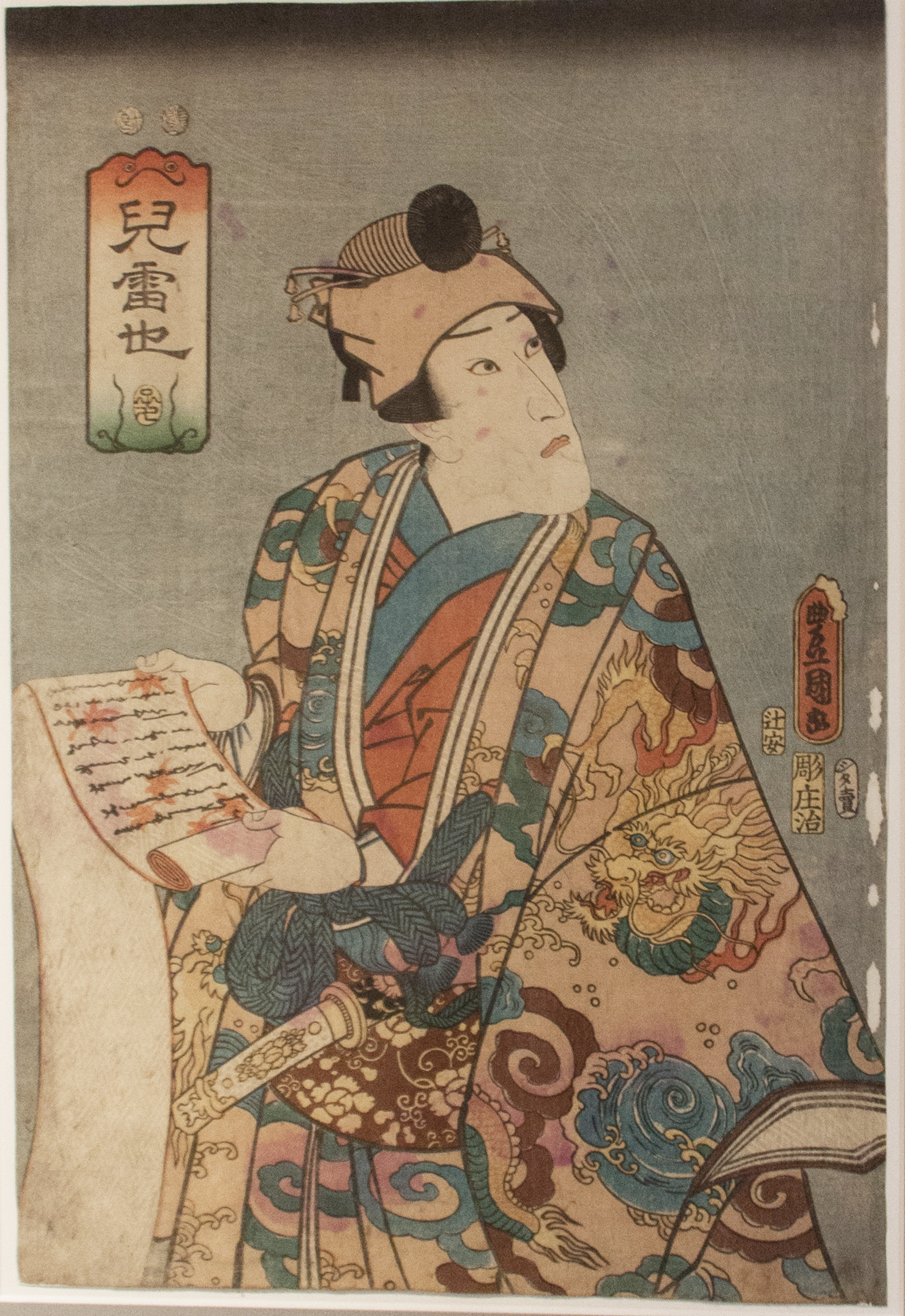
In 1839, a serialised novel called Jiraiya Goketsu Monogatari began publication in Edo. Its hero — a toad-riding ninja of supernatural abilities — became one of the defining cultural figures of the period, adapted for kabuki, woodblock prints, and popular illustration. This is the kabuki actor Ichikawa Danjuro VIII in the role, 1852. The supernatural ninja of cinema does not come from the historical manuals. It comes from Jiraiya, and from the popular fiction that followed him.
Myth vs. Reality
The Onin War
The collapse of the Ashikaga shogunate begins the Sengoku (Warring States) period. Central authority dissolves. The market for mercenary intelligence operatives opens. The shinobi of Iga and Koka begin a century of documented military activity.
Sawayama Castle
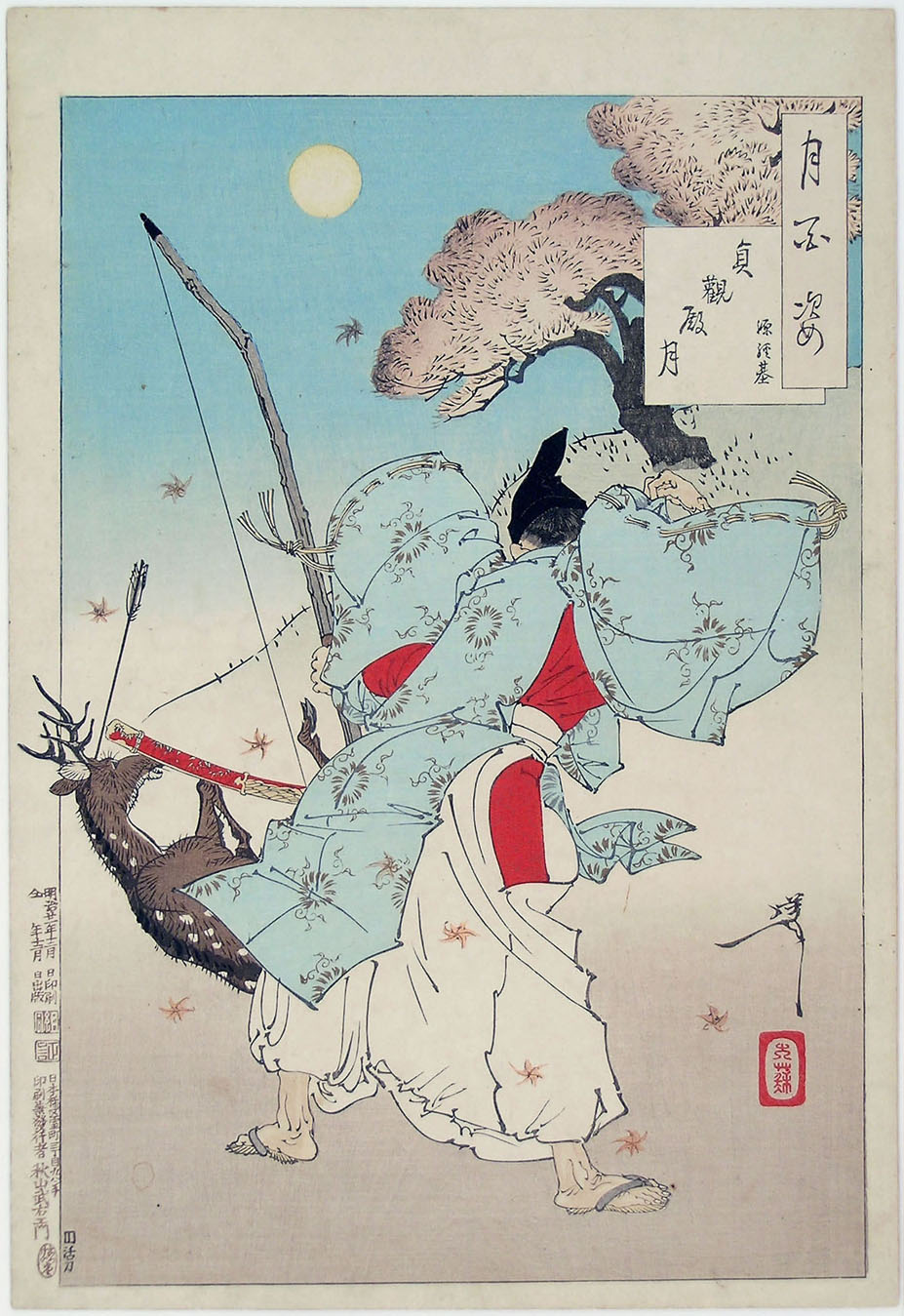
48 Iga/Koka shinobi under Tateoka Doshun infiltrate Sawayama Castle using a stolen clan-crest lantern to move undetected, then set coordinated fires. One of the best-documented examples of real shinobi operations — no magic, precise social engineering.
Tensho Iga no Ran
Oda Nobunaga sends 40,000 troops into Iga Province from six directions simultaneously. The independent Iga confederacy is destroyed. Survivors scatter across Japan, entering service with various daimyo. Hattori Hanzo enters Tokugawa service.
The Bansenshukai
Fujibayashi Yasutake writes the Bansenshukai — 22 volumes of shinobi tradecraft, the most comprehensive intelligence manual ever produced in Japan. He is writing to preserve knowledge that is dying with the peace. The text is practical, not magical.
Jiraiya
The serialised novel Jiraiya Goketsu Monogatari introduces the supernatural toad-riding ninja to mass culture. The theatrical ninja — black-clad, wall-climbing, magically powerful — solidifies in the public imagination.
Enter the Ninja
Cannon Films releases Enter the Ninja, launching the 1980s Western ninja craze. The black costume, the throwing stars, the straight-bladed ninjato (a modern invention with no historical basis), the superhuman abilities — the complete mythology arrives in Western cinemas.
Key Figures
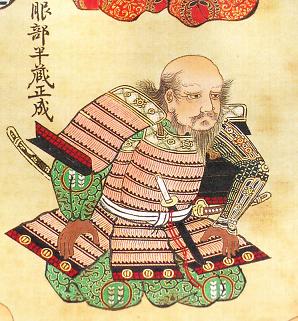
Hattori Hanzo
The historical Hattori Hanzō Masanari (c. 1542–1596) was a high-ranking military commander in service to Tokugawa Ieyasu — not a swordsmith living in exile. His most documented action: organising the Iga-goe in 1582, guiding Ieyasu through hostile Iga territory after Nobunaga's assassination, using his network of Iga contacts. Ieyasu rewarded him with command of a 300-man Iga guard unit. He died in service. He was not fictional.
The Black Myth
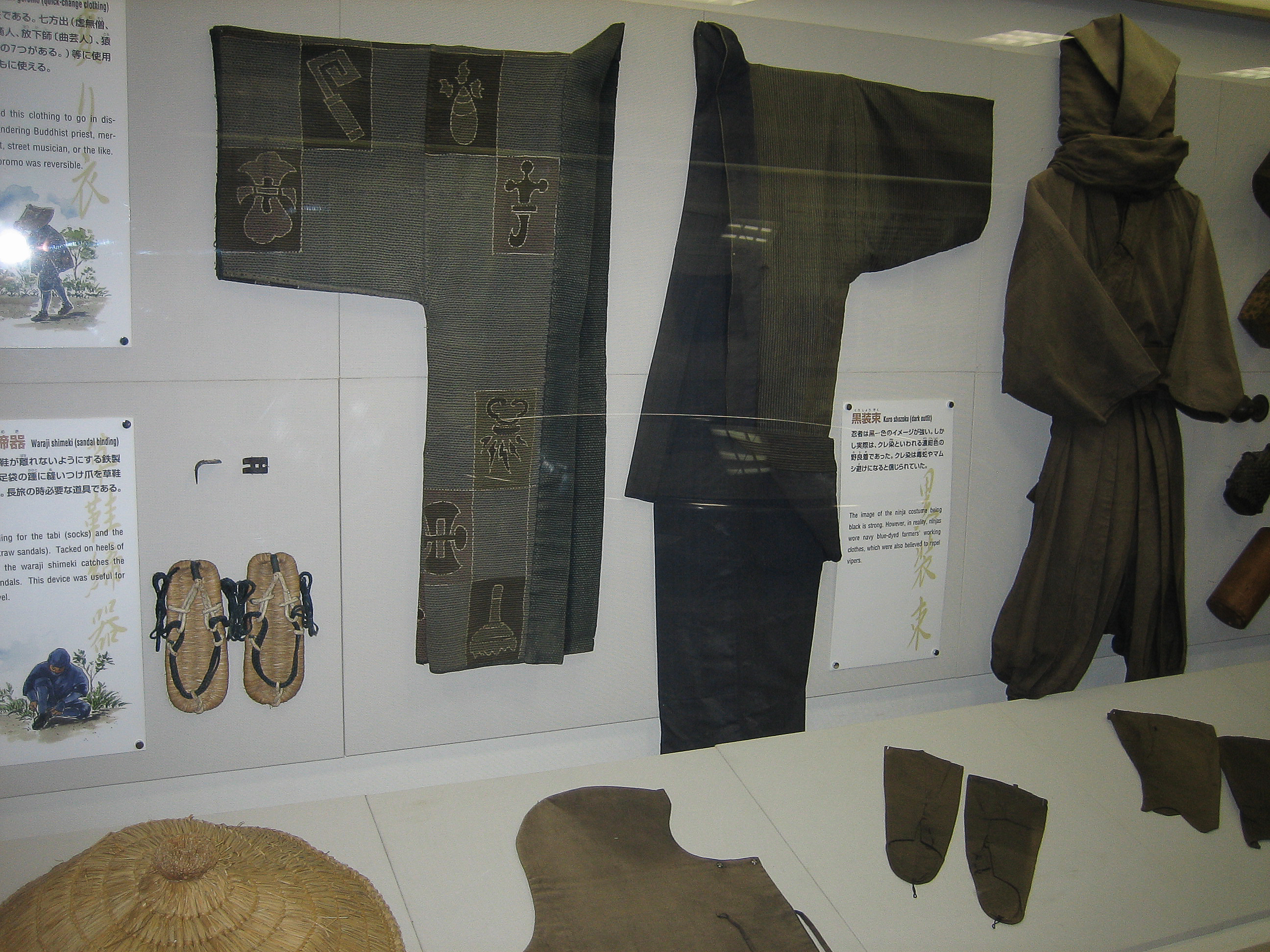
The black shinobi costume on display at the Iga Ninja Museum represents the theatrical tradition — not the historical reality. Real shinobi wore civilian clothing because their work required them to be invisible in plain sight, not in darkness. The black costume originates in the kuroko convention of Japanese kabuki theater, where stagehands dressed entirely in black were conventionally "unseen" by the audience. The theatrical shinobi borrowed this convention. History did not.
They Were Real
The shinobi were real. Three 17th-century manuals describe their methods in practical detail. Historical chronicles document their operations. The Iga ninja confederacy existed as a political entity. Hattori Hanzo commanded a documented military unit. The Tensho Iga no Ran destroyed a real province.
What was not real — what was never real — was the black costume, the supernatural abilities, the straight-bladed ninjato, the wall-climbing, the vanishing in smoke. These came from Edo period popular fiction and 20th century cinema, layered over a quieter and more remarkable truth.
The real shinobi vanished into the crowd. That was always the skill.
Get the Full Book
The complete story — the manuals, the mountain provinces, the theatrical myth, and the men who actually disappeared into history.