
Free with an account
The EPUB is free. Create a HistorIQly account and it downloads straight to your device.
Sign in to download Create a free accountFree account, no card needed. Already have one? Sign in
Your account is ready — enjoy the read.
Download the EPUBFree for everyone with a HistorIQly account.
All EPUBs are in English. Translations are coming.
In February 1959, nine hikers died after leaving a tent on an exposed slope in the northern Urals. Searchers found equipment inside, tracks downhill, and bodies in the forest and on the slope. Six deaths were attributed chiefly to cold and three to trauma; the complete sequence remains uncertain.
The Russian prosecutor’s 2020 review favored an avalanche. A 2021 physical model and 2022 field observations support that possibility while leaving several details unresolved.
1959
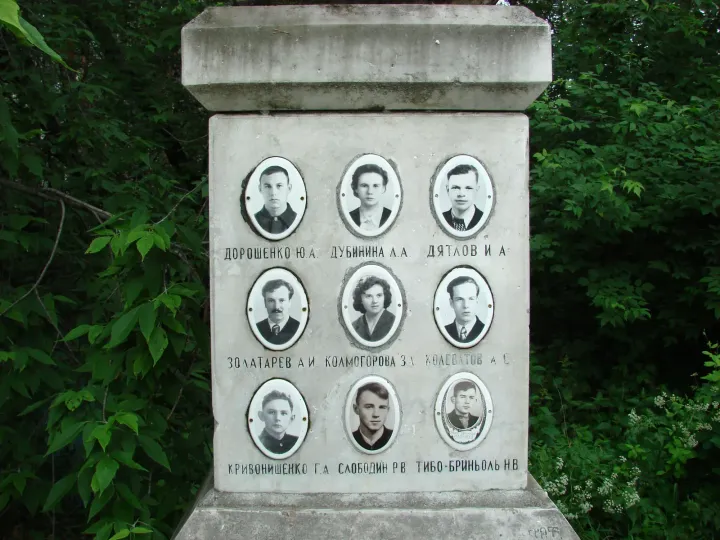
Ten participants began the winter expedition; Yuri Yudin returned because of illness, and the remaining nine died. Most were associated with UPI; instructor Zolotaryov had a different background.
26
Before the tent was found — slashed from the inside, belongings still within.
4m
Beneath several metres of snow in May, about two months after the first bodies were discovered.
May 1959
Access to the 1959 material was limited; copies later became available. A blanket thirty-year security classification is not established here.
The Evidence
The Slashed Tent
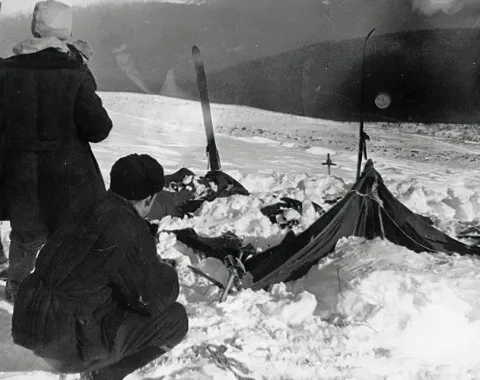
Found on February 26 by student volunteers, the tent was partially collapsed and buried in snow. A long slash had been cut from the inside — the hikers had used knives to escape through the canvas. Inside: boots, warm clothing, food, cameras. Everything they needed to survive had been left behind.
Soviet Case File
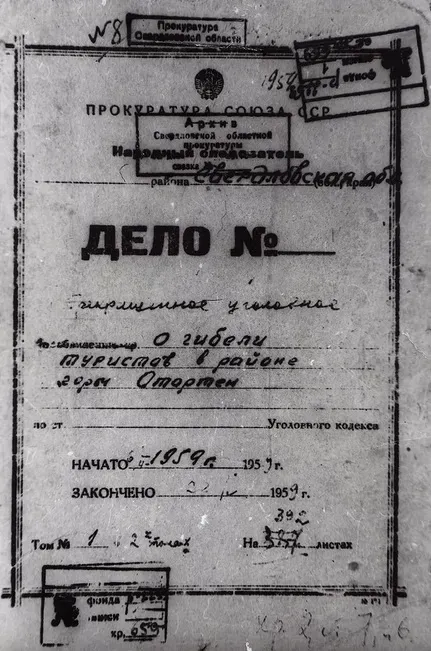
The inquiry collected autopsies and other evidence. Severe chest and skull injuries were closed injuries, not wounds beyond physical explanation. Missing soft tissue in water-exposed bodies was assessed as postmortem change. Ivanov’s later allegations remain distinct from the findings recorded in 1959.
The Avalanche Theory
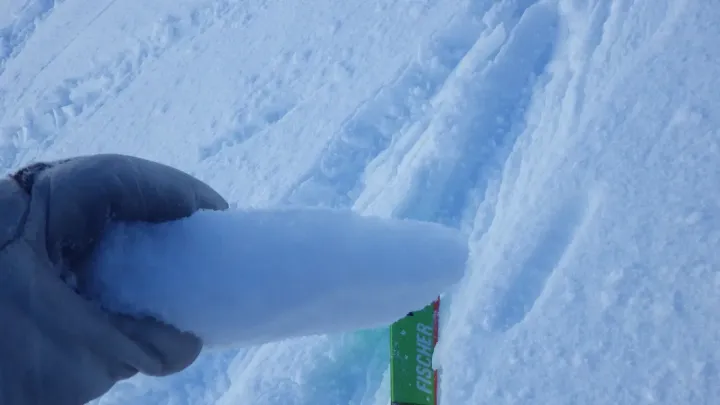
In 2021, Gaume and Puzrin published a model in Communications Earth & Environment. A cut in the snow slope and subsequent wind loading could allow delayed slab release. Their model supports a possible mechanism rather than proving the entire sequence.
Dead Mountain
Point of No Return
Yuri Yudin, the tenth member, turns back due to illness. He says goodbye to his nine friends at the 2nd Northern settlement. He will spend the rest of his life — until 2013 — seeking answers about what happened next.
The Night
The group leaves the tent during the night. Clothing and footwear vary among the victims, and substantial protective equipment remains inside. Tracks lead downhill; the immediate cause of departure is not directly witnessed.
The Tent Found
Search party volunteers discover the tent on the mountain slope — slashed, half-buried, abandoned. All personal effects remain inside. The next day, the first two bodies are found at a cedar tree 1.5 km downhill.
The Ravine
The last four bodies are found in the ravine. Three show severe traumatic injuries; the fourth died of cold. Tissue loss after months of exposure is a separate finding from the injuries incurred during life.
The Answer?
Gaume and Puzrin publish a slab-avalanche model in Communications Earth & Environment. It supports physical plausibility; later surveys find steeper local terrain and nearby avalanche activity. The full 1959 sequence remains uncertain.
Key Figures
Igor Dyatlov
A 23-year-old radio engineering student at the Ural Polytechnical Institute. Experienced, methodical, and respected by his peers. He organized the Grade III winter expedition to Mount Otorten. His body was found 300 meters from the cedar tree, on his back in the snow, with a position interpreted as a possible attempted return.
Semyon Zolotaryov
The oldest participant, Zolotaryov was a wartime veteran and hiking instructor, aged about thirty-seven or thirty-eight depending on the reported birthday. His different background does not establish an intelligence role.
A Compelling Natural Force
The 1959 inquiry concluded that the hikers had been overcome by a natural force. The 2020 prosecutor’s review gave an avalanche explanation; neither document supplies every individual action.
The avalanche hypothesis has a physical basis. That matters even where details remain uncertain. The evidence also preserves efforts to make a fire, obtain clothing and find shelter after the tent was abandoned.
Get the Full Book
Follow the expedition, the surviving evidence and the investigations into a fatal winter night.